

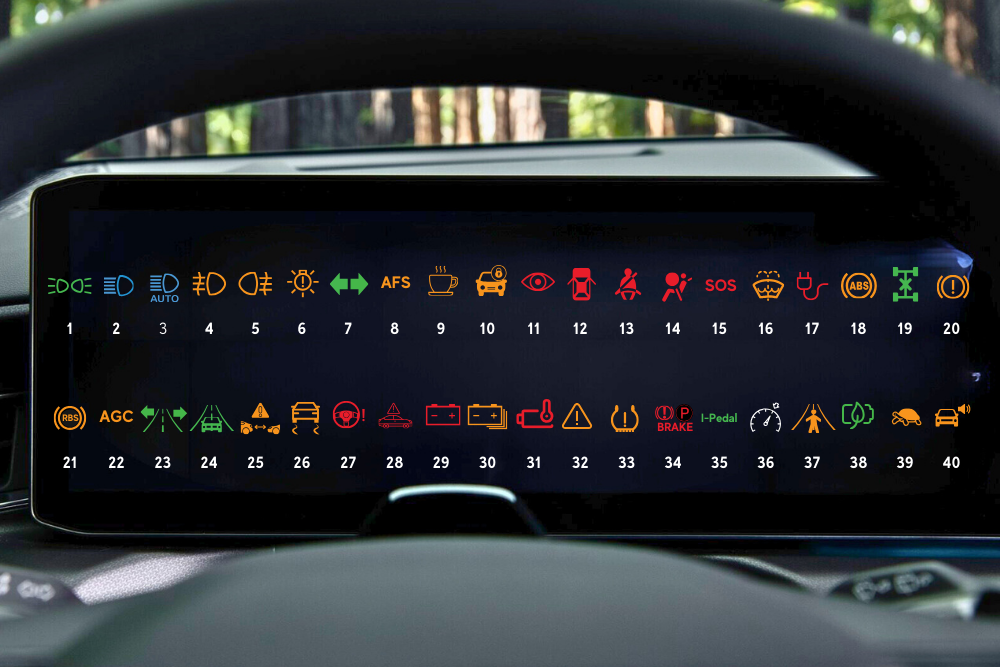
From the first driving lesson, you start to recognise the symbols that frequently appear on your car's dashboard. With the dashboard hosting a variety of lights to both alert and assist the driver, these range from safety alerts and warning indicators to driving assistance controls.
What were once additional features have become standard safety features, along with new driver assistance technologies and EV specific symbols, the variety of symbols displayed on a car's dashboard is increasing. This guide summarises 40 common symbols found on an EV dashboard, also known as an Instrument Cluster.
EV dashboard symbols can vary slightly across different manufacturers, however, a standardised set of colour codes exists, enabling drivers to understand the issue highlighted on the dashboard.
- Green indicates that the system is functioning correctly or is in use.
- Yellow/Orange signifies that there is a malfunction; proceed with caution and investigate promptly.
- Red alerts to a serious and potentially hazardous issue
- Blue denotes caution
- White indicates that the system has not been activated yet
1. Lights On Indicator
This symbol shows that the vehicle lights are on.
2. Beam Indicator
This symbol shows that a high / full beam is on. When the lines dip, this shows that a low / dipped beam is on.
3. High /Full Beam Assist (Automatic Full Beam)
Many EVs have beam assist, when activated, the EV will automatically switch between high or low beam, depending on oncoming traffic.
4. Front Fog Lamp
This indicates that the vehicle's front fog lights are activated.
5. Rear Fog Lamp
This indicates that the vehicle's rear fog lights are activated.
6. Lights
This symbol typically signifies an issue with one of your vehicle's lights. It is advisable to inspect all lights, such as headlights, indicators, brake lights, and reverse lights, to ensure they are functioning properly. If necessary, replace any faulty bulbs and consult a mechanic if the problem persists after replacement.
7. Indicators / Hazard Lights
Flashing green arrows indicate that the turn signals or hazard lights are active. If the arrows point in both directions, it signifies that the hazard lights are engaged, causing all four indicator lights to flash. Conversely, if there is a single arrow pointing left or right, it indicates that the corresponding left or right turn signal is in use.
8. Adaptive Front Lighting System
Adaptive Front Lighting Systems (AFS) aim to dynamically adjust a vehicle's headlights, providing the driver with optimal night vision while ensuring the safety of other road users. If the AFS symbol appears on the dashboard, in orange this may indicate a malfunction within the system.
9. Driver Attention Warning
Many electric vehicles are equipped with a Driver Attention Warning (DAW) system. This alert activates when the vehicle detects a change in driving patterns, suggesting the driver may be fatigued or losing control of the vehicle. The DAW symbol serves as a prompt for drivers to take a rest.
10. Immobiliser
If a warning light related to the immobiliser illuminates on the dashboard, it could signify a malfunction in the vehicle's security system.
11. In Cabin Camera
The in cabin camera is often used to ensure drivers are paying attention, should this symbol flash it is to alert the driver and remind them to keep their eyes on the road ahead.
12. Door Open
This symbol indicates that a door is open, and the vehicle should not be driven until the door is securely closed. Most cars display exactly which door is not closed properly allowing drivers to quickly address the issue.
13. Seat Belt Warning
This symbol appears when a person or an object is seated in the vehicle without the seatbelt fastened. Most vehicles will also indicate which specific seat is triggering the alert.
14. Airbag Waring Light
When red, the Airbag warning light indicates a fault with one of the vehicles airbags. It is essential to address this issue promptly, as a malfunctioning airbag can compromise your safety in the event of an accident.
15. E-Call
The eCall SOS is an integrated safety feature in vehicles that automatically activates during an incident when the airbags deploy. Additionally, it can be manually triggered by the driver or passenger by pressing a button. The appearance of this symbol signifies that a call has been initiated.
16. Washer Fluid
An orange light signals that the washer fluid is low or empty. It reminds drivers to refill their washer fluid to maintain clear visibility by cleaning the windscreen during their journey.
17. Charging Indictor
The plug and cable indicator signifies that the vehicle is properly connected to a charging socket. Most vehicles are designed to prohibit driving while connected. If the indicator turns red, it could signal an issue with charging.
18. Anti-lock braking system
The Anti-Lock Braking System (ABS) is a crucial safety feature that becomes particularly important when making sudden stops or driving on challenging surfaces such as icy roads. If the ABS warning light activates alongside the brake warning light, it may signify a potential failure in the brake system. In such cases, it is advised to halt the vehicle immediately and seek recovery services.
19. 4 Wheel Drive (4WD) lock indicator
A 4-wheel drive system automatically locks the differential, which is designed to allow wheels to rotate at different speeds, to navigate hills or poor driving surfaces effectively.
The indicator light activates when the differential lock system is engaged and can be turned off using the corresponding button on your dashboard.
20. Brake Light warning
If the red light persists after releasing the parking brake, or illuminates while driving, it may signal a low brake fluid level or a malfunction in the Automatic Braking System, which would also activate the ABS warning light.
21. Regenerative Braking
Regenerative braking is a feature in electric vehicles that transforms the kinetic energy produced during braking into electricity, which then recharges the battery. If this symbol lights up in amber or red, it signifies a significant malfunction in your EV's Regenerative Braking System (RBS).
22. Auto Glide Control
This indicator will illuminate when the car engages the 'auto-glide' feature. In this mode, the electric motor's output is regulated to minimise deceleration forces, permitting the vehicle to coast at a constant speed, thereby improving the driving range.
23. Lane Change Assist
Lane Change Assist (LCA) is a technology that employs sensors to detect and alert drivers to vehicles approaching in adjacent lanes. When this symbol illuminates on the dashboard, it signifies whether it is safe to change lanes or if a vehicle is in the blind spot.
24. Lane Keeping Assist
The lane keep assist system acts as a safety net when your electric vehicle deviates from its lane. A light activates if the vehicle approaches lane markings without the turn signals engaged. Some electric vehicles will also apply steering torque and trigger vibrations in the steering wheel to notify you of your position on the road.
25. Forward Collison Avoidance Assist
The system utilises a sensor to scan the road ahead, gauging the distance and relative velocity of the vehicles in front, this light provides a warning if you approach too closely.
It primes the brakes for emergency stopping if a collision risk is detected, boosting your braking force. Should a crash become unavoidable, some systems will autonomously engage the brakes and tighten the seatbelts to secure the occupants.
26. Electronic Stability Control
This warning light indicates a problem with the traction control system. If it's flashing, it means the ESP system is intervening, such as when you're driving on a slippery road. If the light remains on, it signifies that the ESP system is malfunctioning. The ESP light will also illuminate with the word 'OFF' if the system has been deactivated, which may have been done inadvertently.
27. Power Steering Warning
Also known as the EPS or EPAS warning light, when red this indicates that there’s a problem with the power steering, you will notice that the car is harder to manoeuvre and you should have the car checked.
28. EV System Error
Similar to the Master Warning, the "EV System Error" or "EV Service Required" warning serves as a comprehensive alert indicating that one or more diagnostic trouble codes have been logged in your electric vehicle's (EV) system.
29. 12 V Battery Warning
If this light comes on when you’re driving it indicates that the 12v battery is not charging.
30. High Voltage Battery Level Warning
The current charge of your vehicle's battery is depicted by a battery icon that depletes as the car's battery is used. If this icon appears, it signifies that your vehicle requires charging before the range depletes, typically activating when an EV reaches only 20% of remaining charge.
31. Battery Temp
The battery symbol illuminates in electric vehicles (EVs) when the battery temperature is elevated. In traditional vehicles, a similar warning is conveyed through the engine light. Should this icon appear, it is advisable to safely pull over, halt, and turn off the vehicle for some time. It is recommended to have your vehicle inspected.
32. Master Warning Light
The dashboard warning light can indicate various faults in a car. To determine which specific issues are associated with this light, consult your vehicle's handbook.
33. Tyre Pressure
When the light turns orange, indicating that the tyre pressure is low, you should inspect your tyres for any punctures or add more air to your tyres or replace as needed.
34. Parking Brake
The Parking Brake/Hand-Brake Warning Light symbol signifies that the parking/emergency/hand-brake is currently activated.
35. I-Pedal
Some electric vehicles (EVs) are equipped with one-pedal driving, also known as 'i-Pedal.' When this symbol is displayed, it indicates that one-pedal driving is active. The 'i-Pedal' driving mode also maximises energy recovery from the brakes and allows the driver to smoothly stop the car without the need to press the brake pedal.
36. Adaptive Cruise Control
Cruise Control, when activated, maintains the speed set by the driver. Additionally, the Adaptive Cruise Control (ACC) feature enables the selection of a safe following distance from the vehicle ahead. The system will autonomously engage the brakes and alert the driver if this distance decreases. A green indicator signifies that ACC is active, while orange or red signals a malfunction in the system.
37. Pedestrian Warning
This warning light notifies EV drivers of nearby pedestrians or other road users to prevent accidents and collisions. Should the driver fail to react quickly by braking, some EV's automatic braking systems will engage.
38. Eco Mode
To maximize the distance your vehicle can travel on a single charge, it's advisable to utilize eco mode frequently. Eco mode enhances your electric vehicle's efficiency by limiting acceleration, which is known to deplete the battery quickly. Remember, eco mode is a selectable feature, so the corresponding symbol will only appear when it's active.
39. Limp Mode
The tortoise symbol signifies that the EV is operating on limited power. Typically, you will be alerted to charge your vehicle before this symbol appears. It's crucial to heed this warning, as it often means the vehicle will enter a 'limp' mode en route to the next charging point, resulting in reduced speed and the deactivation of heating and other features to conserve energy. This condition could also stem from an electrical issue, battery power or temperature anomalies, or other malfunctions. Should the warning light persist after recharging, a professional inspection of your electric vehicle is advised.
40. External Sound System Warning
Electric vehicles are significantly quieter than their petrol or diesel counterparts, which can make them difficult for pedestrians and other road users to detect. The External Sound System Warning, commonly referred to as the Pedestrian Alert, produces an electronic noise at low speeds, such as during parking manoeuvres, to warn pedestrians. Should the system's symbol illuminate, it indicates a potential fault in the alert mechanism.
Benefits of Maintenance Packages
End of Contract - Fair Wear and Tear Guides